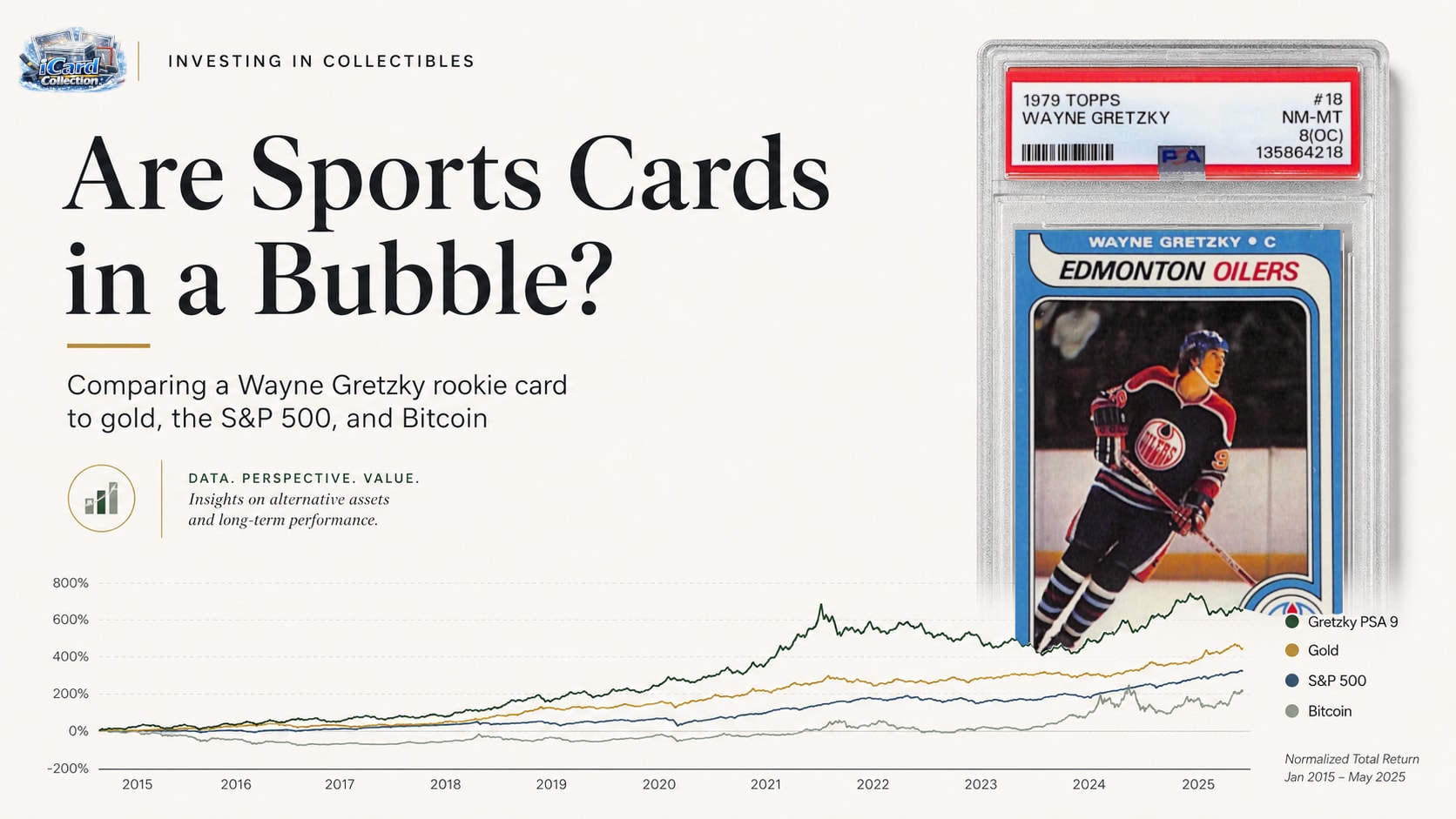
Sports cards have always had value to collectors. But over the last several years, the conversation around sports cards has changed. They are no longer discussed only as childhood keepsakes, hobby items, or pieces of sports nostalgia. Increasingly, high-end sports cards are being treated like alternative assets.
That shift is not theoretical. Institutional investors, entrepreneurs, and high-profile collectors have entered the space. In 2025, the 2007-08 Upper Deck Exquisite Collection Dual Logoman Autographs Michael Jordan and Kobe Bryant 1-of-1 sold through Heritage Auctions for $12.932 million, becoming the most expensive sports card ever sold at public auction. Heritage reported that the buyer group included Kevin O’Leary, Matt Allen, and Paul Warshaw.
That kind of sale raises an obvious question:
Are sports cards becoming a serious alternative asset class, or are parts of the market in another asset bubble?
The answer depends on what part of the market you are talking about. Iconic vintage cards, modern low-numbered parallels, graded rookie cards, prospect cards, and mass-produced base cards are not the same thing. Treating them all as one market is where the conversation usually starts to break down.
To frame the question, let’s look at one of the most important hockey cards ever made: the 1979 Topps Wayne Gretzky rookie card in PSA 9 condition.
The Gretzky PSA 9 vs. Traditional Assets
Using December 2008 as a starting point gives us a useful benchmark. Asset prices had been reset during the financial crisis, and the years that followed became a major growth period for stocks, gold, Bitcoin, collectibles, and other alternative assets.
Based on the card price data used for this analysis, a 1979 Topps Wayne Gretzky rookie PSA 9 sold for about $1,421 in December 2008. A recent sale/value point used here is $37,800.
That is a massive move.
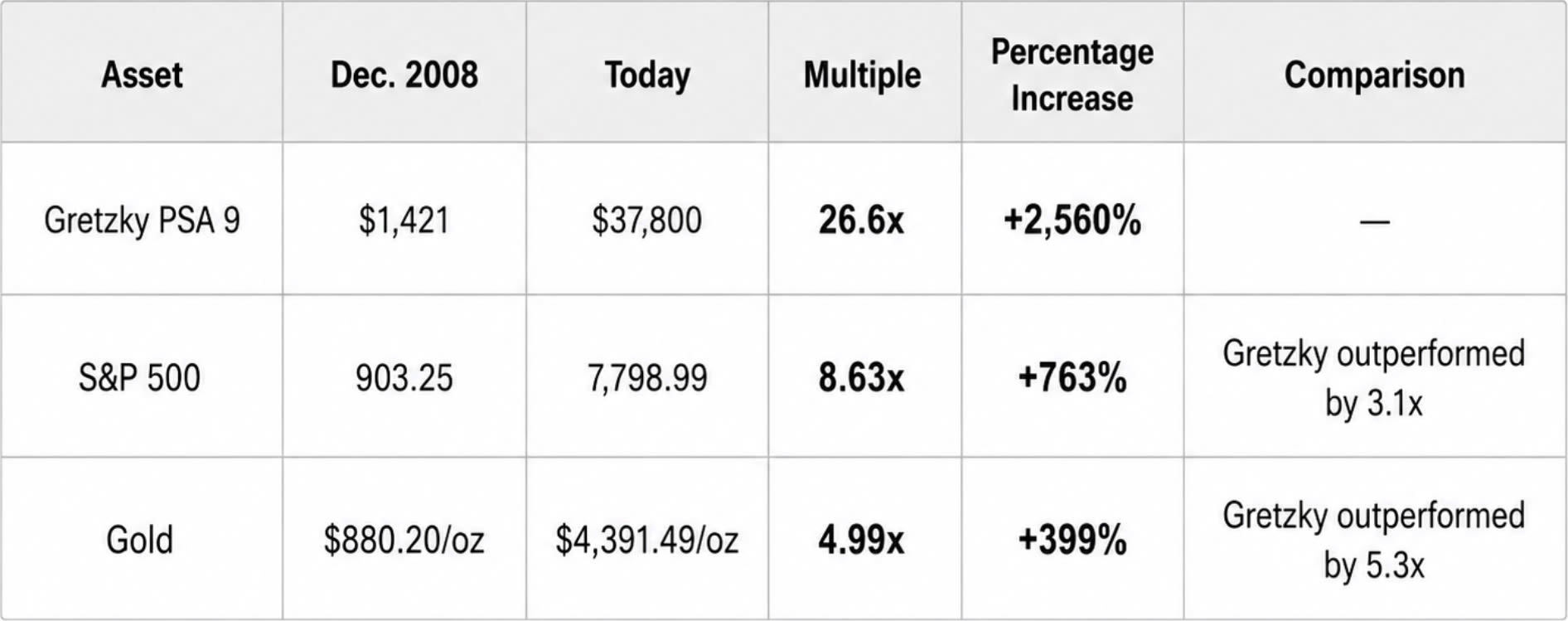
The S&P 500 closed at 7,798.99 on August 13, 2026, according to AP and Reuters reporting. Reuters also reported spot gold at $4,391.49 per ounce on August 14, 2026.
Against traditional benchmarks, the Gretzky PSA 9 looks extraordinary. It outperformed gold by more than five times and the S&P 500 by roughly three times. At first glance, that looks like a bubble.
But traditional assets may not be the only fair comparison.
Should Sports Cards Be Compared to Bitcoin?
Gold is one of humanity’s oldest stores of value. The S&P 500 is the modern financial benchmark. But sports cards, at least as a serious investment category, are closer to an emerging alternative asset class. That makes Bitcoin a useful comparison.
Bitcoin is scarce, belief-driven, volatile, and still relatively new compared to gold or public equities. Sports cards share some of those same characteristics. Their value is driven by scarcity, cultural relevance, collector conviction, market liquidity, and belief in future demand.
Using January 2020 as a more modern comparison point gives a different picture. This was right before the COVID-era explosion in both alternative assets and sports cards.
Based on the card price data used for this analysis, the Gretzky PSA 9 was worth about $8,880 in January 2020. Bitcoin closed at $7,200.17 on January 1, 2020, according to StatMuse.
Using a recent Bitcoin price around $62,800, the comparison looks like this:
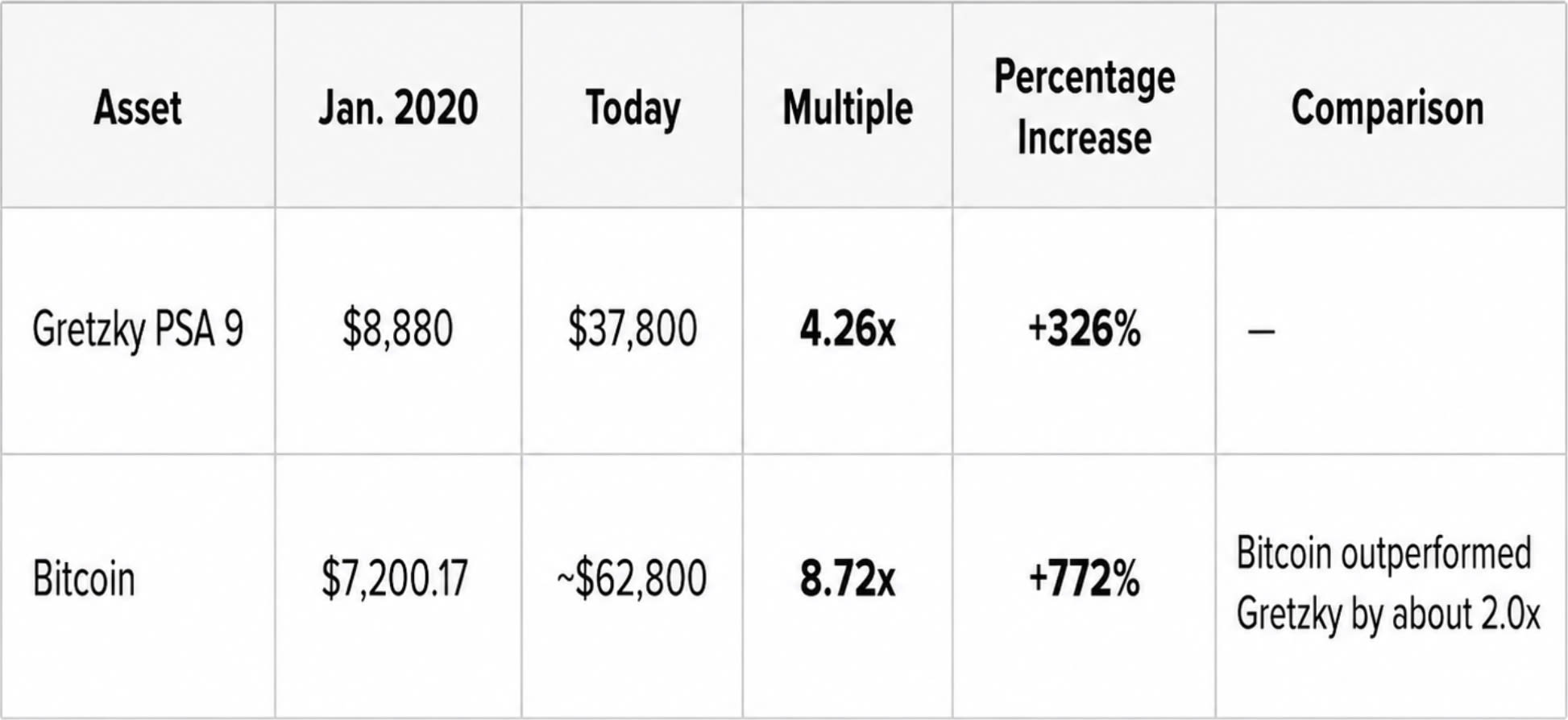
This changes the framing.
Compared to gold and the S&P 500, the Gretzky PSA 9 looks almost absurd. Compared to Bitcoin, it still performed incredibly well, but it no longer looks completely detached from the behavior of other emerging, scarcity-based assets.
That leads to the real question: Are elite sports cards being properly repriced as scarce cultural assets, or are collectors and investors using a few blue-chip examples to justify bubble-like pricing across the broader market?
The Bull Case: Why the Rise in Sports Card Values Could Be Legitimate
There is a real case that high-end sports cards deserve to be viewed differently than they were twenty years ago.
1. True scarcity exists in vintage flagship cards
They are not making any more 1979 Topps Wayne Gretzky rookie cards. That matters.
A vintage flagship rookie card is different from a modern card that can be recreated through new parallels, inserts, short prints, variations, and manufactured scarcity. With an iconic vintage card, the supply is largely fixed. The card already exists. The population is known, or at least knowable. Higher-grade examples become even more limited.
A PSA 9 Gretzky rookie is not just a piece of cardboard. It is one of the most recognizable hockey cards ever made, in a grade most surviving copies will never reach.
That combination of historical importance and limited supply is the foundation of the bull case.
2. Grading created structure
Grading changed the sports card market.
Before third-party grading became central to the hobby, condition was more subjective. A card was “nice,” “clean,” “near mint,” or “rough.” Today, grading companies like PSA, BGS, and SGC give cards a standardized condition label that buyers can compare across listings, auction houses, and marketplaces.
That standardization made sports cards easier to price, easier to trade, and easier to treat like financial assets.
A PSA 9 is not just a card. It is a card plus a condition grade, a population report, a market history, and a pricing tier.
That is a major reason why high-grade cards can command such large premiums.
3. Cultural importance has real value
Wayne Gretzky is not just a hockey player. He is one of the most important figures in sports history.
That matters because sports cards are not purely financial instruments. They are cultural objects. They represent athletes, moments, childhood memories, fandom, identity, and status.
Gold does not have a favorite team. A stock certificate does not remind someone of watching hockey with their father. Bitcoin does not have a rookie season.
Sports cards are different because their demand is emotional as well as financial. Collectors buy them because they mean something. Investors buy them because other people believe they mean something.
That emotional layer can support prices in a way that traditional financial models often struggle to measure.
4. Serious money validates the category
When investors like Kevin O’Leary participate in record-setting card purchases, it does not automatically mean every sports card is a good investment. But it does show that high-end collectibles are being taken seriously by people outside the traditional hobby.
The Jordan/Kobe Logoman sale was not just a hobby headline. It was a signal that rare sports cards are being evaluated as cultural assets, trophy assets, and alternative investments.
That kind of attention brings more capital, more visibility, and more legitimacy to the market.
The Bear Case: Why This Could Still Be a Bubble
The bull case is real. But so is the risk.
Sports cards may be emerging as an alternative asset class, but the market still has major weaknesses.
1. Modern card supply is being diluted
Vintage flagship cards have fixed supply. Modern cards do not always have that same protection.
In older eras, a player might have one or two key rookie cards. Today, a star rookie can have dozens of cards across multiple products, parallels, colors, short prints, autographs, memorabilia cards, and one-of-ones.
That creates a problem.
Scarcity is powerful when it is organic. It becomes more questionable when it is manufactured repeatedly.
A one-of-one card sounds rare. But if a player has dozens of different one-of-ones across different sets, products, and variations, the term starts to lose some of its force.
This does not mean modern cards cannot be valuable. Some absolutely can be. But modern scarcity is more complicated than vintage scarcity.
A Gretzky PSA 9 and a modern low-numbered rookie parallel are not the same type of asset, even if the market sometimes prices them like they are.
2. Grading can create confidence, but also doubt
Grading helped professionalize the market, but it also created new problems. Collectors know that grading can be inconsistent. A card graded PSA 9 might be cracked out, resubmitted, and eventually receive a PSA 10. Sometimes that may reflect a genuine difference in evaluation. Other times, it creates the perception that grading depends too much on timing, subjectivity, or the individual grader.
That matters because the financial difference between grades can be enormous. If the market is going to treat graded cards like assets, then confidence in grading standards becomes essential. Any perceived inconsistency weakens trust in the system.
This is normal for a maturing asset class, but it is still a risk.
3. There is no true intrinsic valuation model
Stocks can be valued using revenue, earnings, cash flow, margins, growth rates, dividends, and comparable companies.
Sports cards do not have that.
A card is worth what someone is willing to pay for it. That sounds simple, but it creates a major problem: it is hard to know where the true floor is.
Is a Gretzky PSA 9 worth $25,000, $40,000, $80,000, or $100,000?
There is no formula that can definitively answer that. The market can look at past sales, population reports, auction activity, player significance, and collector demand. But at the end of the day, pricing is still based heavily on perception. That makes sports cards vulnerable to hype cycles.
The Market Dynamic That Matters Most: Liquidity
Liquidity may be the most important part of this entire conversation. Sports cards are not liquid like stocks or Bitcoin.
If you own shares of a major company, you can usually sell instantly during market hours. If you own Bitcoin, you can sell nearly instantly on an exchange. If you own a high-end sports card, the process is different. You need to list it, consign it, auction it, negotiate privately, ship it, insure it, and find a real buyer willing to pay the price.
That lack of liquidity cuts both ways.
When demand is strong, low liquidity can push prices up quickly. If only a few copies are available and collectors are holding the rest, buyers have limited options. A seller can stretch the asking price because there may not be another comparable card available.
In that environment, the seller is in control.
But when demand weakens, the opposite happens. If multiple sellers need liquidity at the same time, buyers gain control. A couple of lower sales can reset comps quickly. The same thin market that pushes prices up can pull them down just as fast.
That is why card prices can move violently. The last comp is not always the true market price. Sometimes it is just the last person willing to pay up.
The 2021–2022 Crash Proves the Risk Is Real
If sports cards can go up like assets, they can also come down like assets. The Gretzky PSA 9 is a good example. Based on the card price data used in this analysis, a PSA 9 Gretzky sold for about $78,000 in March 2021. By April 2022, the same card was around $26,000.
That is a decline of roughly 67%.
This is important because it shows that even elite cards are not immune to bubble-like behavior. A card can be historically important, scarce, graded, and culturally meaningful — and still become overpriced during a speculative run.
At the same time, the story does not end there. The Gretzky PSA 9 later recovered from those lows and has spent time trading in a more stable range. That may suggest the 2021 peak was the bubble, while the current market is trying to find a more durable floor.
But that is exactly the point.
Sports cards can be legitimate assets and still experience bubbles.
Vintage and Modern Cards Should Not Be Treated the Same
This is where the sports card investment conversation needs more nuance. The market is not one market.
Vintage flagship cards are different from modern prospect cards. A high-grade Gretzky rookie is different from a modern rookie parallel. A historically important card is different from a manufactured low-numbered insert. A collector grail is different from a short-term flip.
Vintage flagship cards have several advantages:
- established cultural importance
- fixed supply
- long-term collector demand
- decades of market history
- recognizable player legacy
Modern cards often have more uncertainty:
- player legacy is still developing
- supply can be fragmented across many products
- scarcity can be manufactured
- hype can move faster than long-term demand
- prices may depend heavily on short-term performance
This does not mean vintage is always safe or modern is always risky. But it does mean investors and collectors should not treat all sports cards as if they belong in the same bucket.
I would believe the recent sale of the Macklin Celebrini Gold Outburst Young Gun would be the best example of the current state of the modern market. The card recently sold for about $1.28 million USD, but there isn't really anything we can compare it to.
So, Are Sports Cards in a Bubble?
The honest answer is: parts of the market probably are, but the entire market is not.
Elite vintage cards may be emerging as real alternative assets. A card like the 1979 Topps Wayne Gretzky rookie PSA 9 has scarcity, history, cultural importance, grading structure, and collector demand. Those qualities can support long-term value.
But the broader sports card market has clear bubble risks.
Modern supply is expanding. Grading premiums can become irrational. Liquidity is thin. Comps can be misleading. Hype cycles can push prices far beyond what long-term demand can support.
That does not mean sports cards are fake assets. It means the market needs to separate true blue-chip collectibles from cards that are simply being priced like blue-chip collectibles.
The danger is not believing that sports cards can be assets. The danger is treating every sports card like one. You can find our valuing guide here.
Final Thought
Sports cards sit in a strange place between culture, nostalgia, scarcity, and speculation. That is what makes them fascinating. It is also what makes them risky.
Compared to gold and the S&P 500, the Gretzky PSA 9 looks like a staggering success story. Compared to Bitcoin, it looks more like a strong but not unprecedented emerging asset. Compared to its own 2021 peak, it shows how quickly the market can overheat.
That is the real lesson.
Some cards are collectibles. Some cards are investments. A smaller number may become true alternative assets.
But when the market forgets the difference, that is where bubbles form.