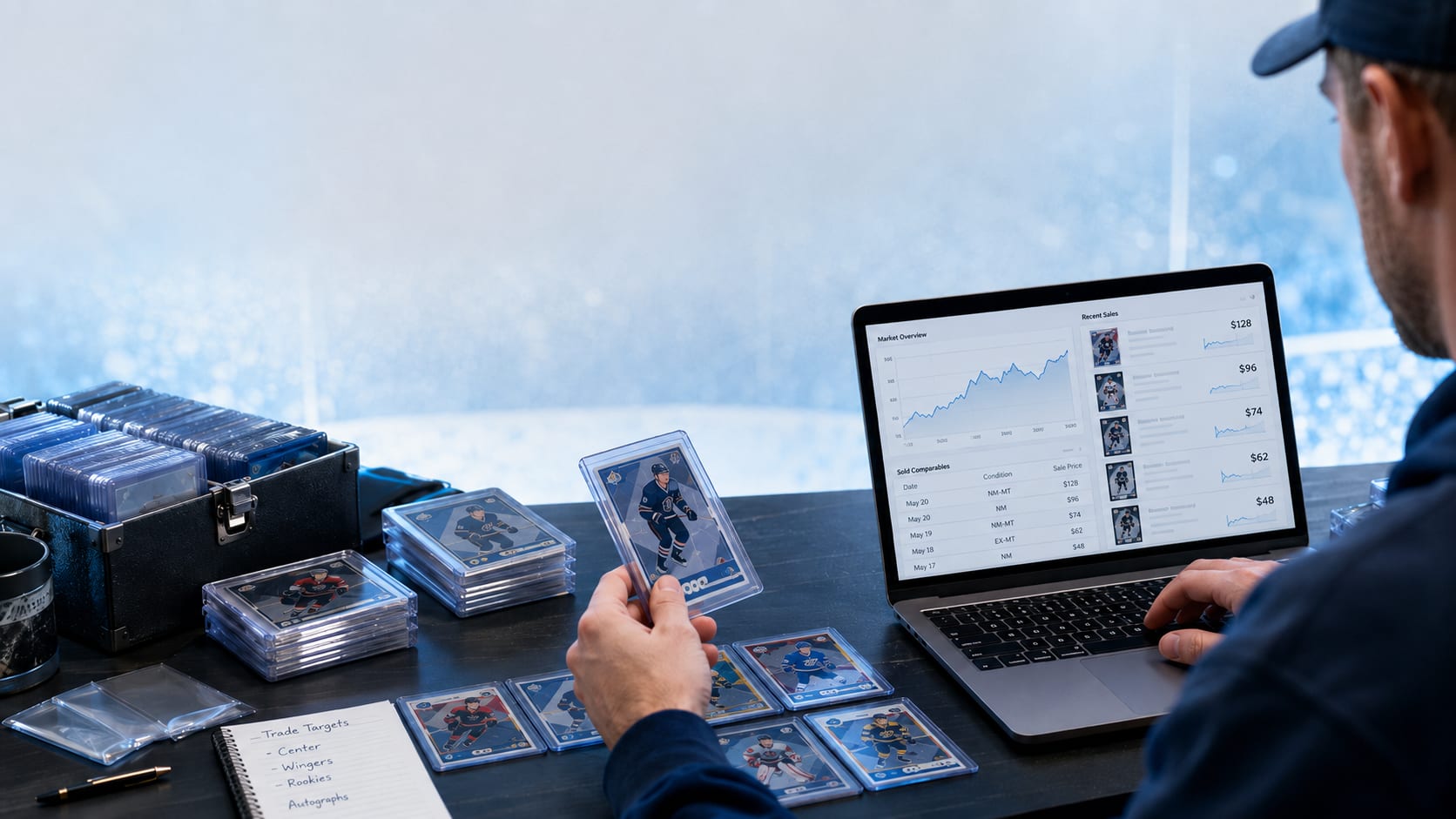
Valuing hockey cards is never as simple as saying, “This card is worth exactly this.”
There are too many variables. The player matters. The set matters. The condition matters. The rarity matters. Timing matters. Demand matters. And sometimes, honestly, the person on the other side of the deal matters too.
Whether you’re trying to value a base Young Guns rookie card or a one-of-one patch auto, there usually is not one perfect number. There is a range. And that range can move fast.
That is part of what makes trading hockey cards fun, but it is also what makes it complicated. Everyone wants to get fair value for their cards. The problem is that collectors often value their own cards at the absolute best-case scenario. And that is usually where headaches start.
If you own the card, it is easy to convince yourself it is worth the highest comp you can find. If you are trying to acquire the card, it is easy to point to the lowest sale and say that is the real value. The truth is usually somewhere in the middle.
And if you want to make fair hockey card trades, you need to learn how to find that middle ground.
Start With Sold Listings, Not Asking Prices
The easiest place most collectors start when trying to value hockey cards is eBay. And that makes sense.
You search the player, the set, the year, the parallel, and suddenly you have a bunch of results in front of you.
The problem is that active listings can be all over the place. One seller might list a card for $100. Another seller might list the same card for $250. Another might list it for $500 because apparently they woke up that morning and chose violence.
But asking prices are not the same as actual value. Anyone can ask whatever they want for a card. That does not mean someone is going to pay it.
That is why sold listings matter so much more than active listings. A sold listing shows that someone actually paid for the card. It gives you a real data point, not just someone’s wishful thinking.
If you see several recent sales around the same price range, you now have a much better baseline for what the card may actually be worth.
Not perfect. But a baseline. And in the hobby, a realistic baseline is usually the best place to start.
Recent Sales Matter More Than Old Sales
Historical sales are useful, but they do not always reflect current value.
A card that sold for $1,000 a year ago might be worth $500 today. It might also be worth $1,500 today. That is why recent comps matter.
Hockey card values can move like small, illiquid markets. A player gets hot, wins an award, gets injured, gets traded, makes a playoff run, gets called up, or disappears from the lineup, and suddenly the value changes.
This is where the hobby starts to feel a little like stocks. Past sales tell you what happened. They do not guarantee what the card is worth today.
When valuing a card before a trade, look at the most recent sales first. Then look at the trend. Are sales moving up? Are they moving down? Are they flat? Did one sale randomly spike above the rest?
A single sale does not define the market.
If a card has consistently sold around $100 and one random copy sells for $150, that does not automatically mean the card is now worth $150. It may just mean someone overpaid, two collectors got into a bidding war, or the auction ended at the perfect time.
The goal is to find a fair range, not one magic number.
Make Sure You’re Comparing the Exact Card
One of the biggest mistakes collectors make when valuing hockey cards is comparing the wrong card. That sounds obvious, but it happens all the time.
A player might have a base Young Guns, a Canvas Young Guns, a Clear Cut, an Exclusives /100, a High Gloss /10, an Outburst, an Outburst Gold, an autograph, a patch auto, and a dozen other variations.
Those are not all the same card. The same player could have one card worth $20 and another worth $2,000. So when you are checking comps, make sure you are looking at the exact year, set, parallel, numbering, grading status, and condition.
Do not just search the player’s name and assume every result applies. That is how bad trades happen.
Condition Changes Everything
Condition is one of the biggest factors in hockey card value. Just because one copy of a card sold for $600 does not mean your copy is worth $600.
If your card has a dinged corner, surface scratches, edge wear, print lines, bad centering, or any other obvious issue, that is going to affect the value.
Two copies of the same card can sell for completely different prices if one is clean and the other looks like it went through a washing machine.
Grading can help create a more standardized value, but even grading is not perfect.
We have all seen cards where you look at a PSA 9 and wonder how it did not gem. We have also seen PSA 10s where you wonder if the grader was just having a good day and wanted to spread joy throughout the land.
Grading gives collectors a useful condition marker, but it is still part of the larger picture.
Raw cards require even more judgment. If you are trading raw cards, condition should always be part of the conversation.
Rarity and Scarcity Matter
Sometimes valuing a card is easy because there are plenty of recent sales. Other times, you are dealing with something much tougher.
If the card is a one-of-one, numbered to five, numbered to ten, or a true short print, you may not find an exact comp. That is when you have to make the best educated guess possible.
You may need to look at similar players, similar sets, similar parallels, or similar cards from the same product. You may need to compare a /10 to a /25 and adjust from there. You may need to see what offers come in and use that as a market signal.
Rare cards are harder to value because the market is thinner. There might not be enough sales to create a clean price range. In those situations, value becomes a lot more subjective. And honestly, that is where trading can get interesting.
Player Demand Is Not Always the Same as Player Skill
Hobby value and real-life hockey value are related, but they are not the same thing.
A great NHL player is not always a great hobby player.
Forwards often carry more hobby value than defensemen or goalies. Big-market teams often get more attention than smaller-market teams. Canadian markets can create intense demand. Rookie hype can drive prices higher than actual production would justify.
Nationality can also play a role. Historically, some Russian players have sold for less than comparable North American players due to factors like collector demand, transfer concerns, league uncertainty, or just general hobby bias. Team matters too.
A promising rookie in Toronto, Montreal, Chicago, or New York may get more hobby attention than a similar player in a quieter market. That does not necessarily mean he is better. It just means there may be more collectors chasing his cards.
That is why demand matters so much. A card’s value is not only about how good the player is. It is about how many people want the card.
Timing Can Create Weird Values
Timing is one of the most underrated parts of valuing hockey cards before trading.
A player goes on a hot streak, and prices jump. A rookie scores a big playoff goal, and suddenly everyone wants his Young Guns. A goalie gets his first NHL start, wins a few games, and collectors start digging through bargain boxes like they discovered buried treasure. But hype can cool quickly.
If you are selling or trading into hype, timing can work in your favor. If you are buying during peak hype, you need to be careful.
This is where recent comps can be misleading if you do not understand what caused them.
Maybe the card is rising because the player is genuinely breaking out. Maybe it is rising because people are temporarily losing their minds. Those are very different things.
Before making a trade, ask yourself: is this value sustainable, or is it being inflated by short-term hype?
That question alone can save you from getting cooked.
Trade Value Is Different From Cash Value
This is where things get interesting. A card’s cash value and trade value are not always the same. If you sell a card, you are trying to get money. Simple enough. But when you trade, there are other factors involved. Desire matters. Convenience matters. Inventory matters. Personal collection goals matter.
If someone really wants a card you have for their PC, they may be willing to give up more trade value than they would in cash. On the other hand, if you are trying to trade a bunch of smaller cards into one bigger card, you may need to offer extra value because the other person is taking on more inventory.
That is not unfair. That is just how trading works. One high-value card is usually easier to move than ten lower-value cards. So if you are the one trading up, expect to sweeten the deal a little.
In trades, value is not just math. It is desire.
A Fair Trade Does Not Have to Be Perfectly Equal Not every trade needs to be perfectly even down to the last dollar.
If both collectors are happy, the trade works.
Sometimes you might give someone a small deal because you know they really want the card. Sometimes someone else might do the same for you. Sometimes the values are close enough and the emotional value matters more than squeezing every last dollar out of the deal.
That is one of the best parts of trading hockey cards. The goal should not always be to “win” every trade. The goal should be to make trades that both people feel good about.
That is also why tools and organized platforms can help. On iCardCollection, collectors can list their trade bait, track player markets, build offers, compare cards, and work through trades in a more organized way. But no tool can completely replace judgment.
At the end of the day, the best way to value hockey cards before trading is to use sold comps as your starting point, adjust for condition, rarity, player demand, timing, and trade context, then find a fair range both collectors can live with.
Because the best trades are not always the ones where someone gets every dollar of value. They are the ones where both collectors walk away excited.