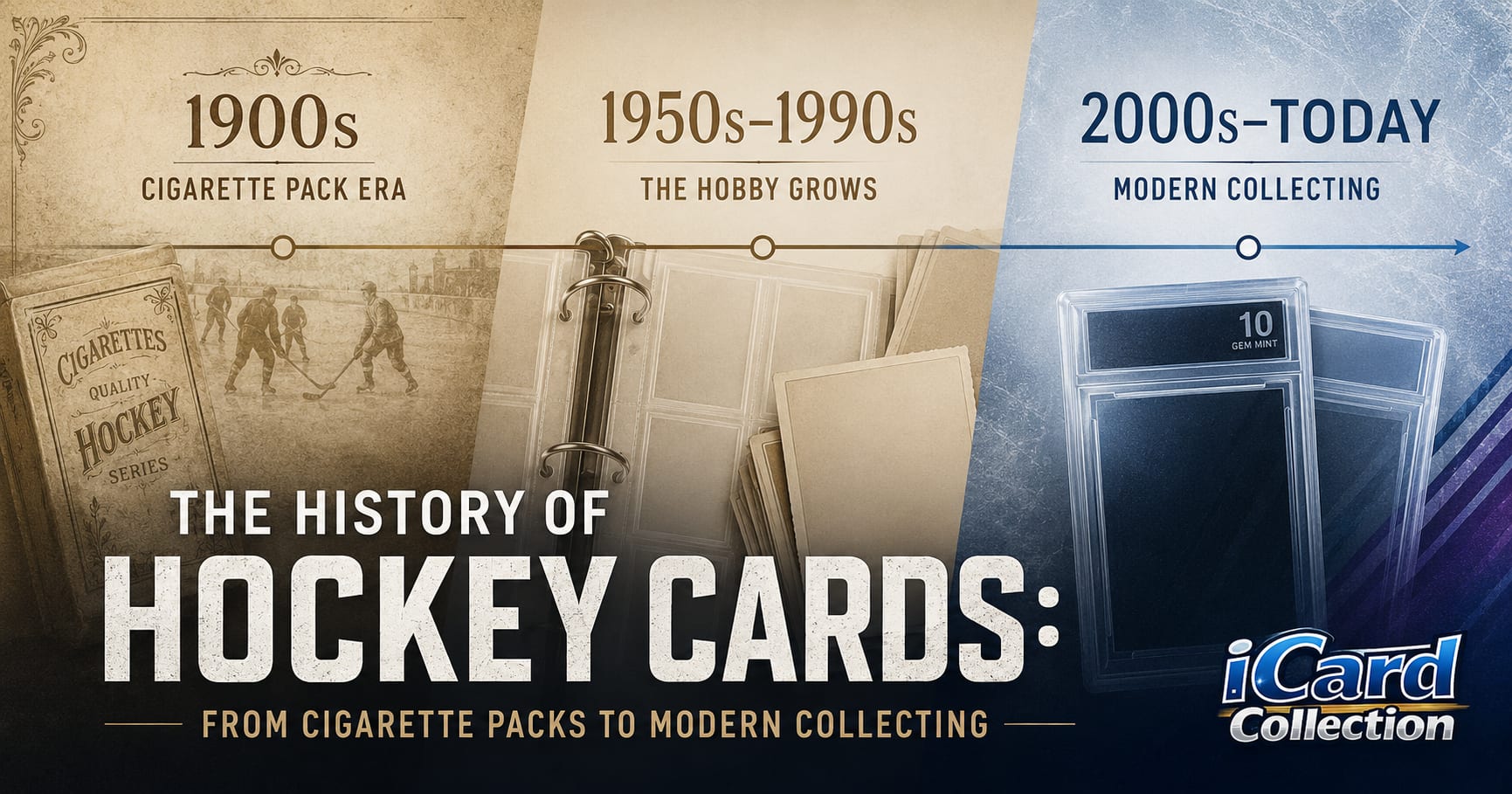
The First Hockey Cards Came From Cigarette Packs
It’s kind of funny when you think about it.
Today, hockey cards are pulled from hobby boxes, blasters, breaks, e-Pack accounts, card shops, shows, online marketplaces, and probably some guy’s basement who still swears he has a mint Gretzky rookie somewhere.
But the first hockey cards did not start as some carefully designed collector product. They started as cigarette-pack inserts.
The first widely recognized hockey cards appeared around 1910–11, when Imperial Tobacco Canada included hockey cards in cigarette packages. These early cards were issued during the National Hockey Association era, before the NHL even existed. The original 1910 set included 36 illustrated player cards, making it one of the earliest foundations of the hockey card hobby.
That detail matters because it shows just how old this hobby really is.
Hockey cards were around before modern arenas, before Original Six nostalgia, before Upper Deck, before Young Guns, before grading, before box breaks, and long before anyone was arguing online about whether wax prices had gotten completely out of control.
The earliest hockey cards were not really made for collectors in the way we think of collecting today. They were advertising pieces. Cigarette cards were commonly used by tobacco companies to promote products, stiffen packaging, and encourage people to keep buying. Sports were just one of many popular subjects used on cigarette cards during that era.
In other words, the first hockey cards were basically marketing that accidentally became history. And honestly, that’s pretty cool.
From Tobacco Cards to Candy, Gum, and Food Products
After those early Imperial Tobacco cards, hockey cards slowly started appearing through other types of products.
During the 1920s and 1930s, hockey cards were printed by food and candy companies such as Paulin’s Candy, Maple Crispette, Crescent, Holland Creameries, and La Patrie.
That era feels very different from the modern hobby.
There were no “hobby boxes.” No guaranteed autos. No numbered parallels. No case hits. No rainbow chase. You were not standing at a card shop counter debating whether to buy singles or rip wax and emotionally ruin your afternoon.
Cards were tied to everyday products. Candy. Gum. Food. Cigarettes...
That is part of what makes vintage hockey cards so interesting. They were not just collectibles. They were pieces of early sports culture, advertising culture, and everyday life. A kid buying candy or an adult buying tobacco might end up with a piece of hockey history without realizing it.
O-Pee-Chee also became part of the early story before World War II. The company produced hockey cards through 1941 before production stopped during the war years.
That pause is important because hockey cards did not just smoothly grow from 1910 to today. The hobby had starts, stops, quiet periods, and full rebirths.
Parkhurst and the Rebirth of Hockey Cards
If Imperial Tobacco represents the birth of hockey cards, then Parkhurst represents the rebirth.
After World War II, hockey cards returned in a more recognizable way during the 1951–52 season with Toronto’s Parkhurst Products.
This is where hockey card collecting starts to feel closer to the hobby people understand today.
Parkhurst cards became one of the defining vintage hockey brands. For collectors who love old-school hockey, Parkhurst carries real weight. The cards feel simple, classic, and deeply connected to the early postwar NHL era.
And that is part of why vintage Parkhurst cards still matter.
They represent a time when hockey cards were becoming something more than random promotional inserts. They were becoming a real part of hockey culture.
Collectors were starting to chase players. Kids were opening packs. Cards were being saved, traded, damaged, thrown in drawers, stuck in boxes, and sometimes somehow surviving long enough to become valuable decades later.
The hobby was starting to look like a hobby.
Topps, O-Pee-Chee, and the Golden Age of Childhood Collecting
Topps entered hockey cards in 1954–55, producing cards featuring NHL teams based in the United States at the time. Then, in 1958, O-Pee-Chee entered into an agreement with Topps to produce NHL cards in Canada.
That partnership helped shape hockey card collecting for decades.
For a lot of collectors, especially Canadian collectors, O-Pee-Chee became more than just a card brand. It became childhood cardboard.
The packs. The gum. The stats on the back. The bilingual text. The annual sets. The feeling of slowly building a team set or trying to land your favorite player.
That era helped turn hockey cards into a true childhood staple.
And this is where the emotional side of the hobby really starts to take over.
Because for many collectors, hockey cards were never just about value. They were about the ritual. Buying packs. Trading with friends. Learning players. Following teams. Sorting cards. Staring at stats. Getting mad because your best card had a wax stain or gum stuck to it like a crime scene.
O-Pee-Chee and Topps helped make hockey cards feel normal, familiar, and accessible.
That accessibility is a massive part of why the hobby lasted.
The Junk Wax Era and the Rise of Modern Hockey Cards
Then came the late 1980s and early 1990s, when the hobby exploded.
This is the era many collectors now call the junk wax era. Production increased, more companies entered the market, and hockey cards became everywhere.
Brands like Pro Set, Score, Pinnacle, Pacific, In The Game, and Upper Deck all became part of the landscape. Suddenly, collecting was not just about a simple annual set. There were more rookies, more inserts, more brands, more boxes, and more speculation.
Upper Deck, founded in 1988, became especially important because it helped push trading cards toward a more premium modern feel with better card stock, photography, holograms, and stronger production quality.
For better or worse, this era changed everything.
On one hand, it created a massive wave of collectors. A lot of people who collect today were introduced to cards during the boom years.
On the other hand, overproduction became a real problem. A lot of cards from that era are still sitting in closets, basements, card shops, and storage units all over North America, waiting patiently to disappoint someone who thinks they found retirement money.
Still, the junk wax era mattered.
It showed how big the hobby could become. It also pushed card companies to innovate with inserts, premium designs, parallels, and new product structures.
Modern hockey cards would not look the way they do today without that period.
The Upper Deck Era and Today’s Hockey Card Hobby
Modern hockey card collecting is heavily shaped by licensing.
Before the 2004–05 NHL lockout, several companies produced licensed hockey cards. After that period, Upper Deck became the dominant licensed NHL card maker. Panini entered the hockey card market in 2010, but Upper Deck regained exclusive NHL and NHLPA rights starting with the 2014–15 season.
That licensing shift is a huge reason hockey cards feel different from other sports.
In baseball, basketball, and football, collectors often debate different rookie card brands and manufacturers. In hockey, the market has become much more centered around Upper Deck products.
That is why products like Young Guns, SP Authentic Future Watch Autos, The Cup rookie patch autos, O-Pee-Chee Platinum, Stature, Allure, ICE, and Extended Series all sit under the same broader Upper Deck ecosystem.
Today, hockey cards are no longer just base cards in a pack of gum.
The modern hobby includes rookie cards, parallels, autographs, memorabilia cards, rookie patch autos, serial-numbered cards, graded slabs, case hits, online breaks, digital collections, card shows, marketplaces, trade nights, and collector communities.
It is a completely different world from the Imperial Tobacco cards of 1910.
But at the same time, the core of the hobby has not changed as much as it might seem.
Collectors still chase players they love. They still trade. They still show off favorite cards. They still argue about value. They still get excited over rookies. They still open packs hoping something amazing is waiting inside.
The technology changed. The products changed. The prices definitely changed.
But the feeling is still pretty similar.
Why the History of Hockey Cards Still Matters
The history of hockey cards matters because it reminds us that this hobby was not built overnight.
It started with cigarette-pack inserts. It moved through candy and gum. It survived war interruptions. It grew through Parkhurst, Topps, and O-Pee-Chee. It exploded during the junk wax era. It evolved through Upper Deck, Young Guns, premium releases, grading, and online collecting.
And now, in 2026, hockey card collecting is still changing.
Collectors are buying online, trading online, joining breaks, showcasing personal collections digitally, and building communities around the hobby in ways that would have been impossible decades ago.
But the reason hockey cards still matter is not just because some of them are valuable. It is because every card is a tiny piece of hockey history.
Some represent legendary players. Some represent childhood memories. Some represent teams, cities, eras, designs, products, and moments in the sport.
That is what makes hockey card collecting special. The hobby has come a long way from cigarette packs. And honestly, that is what makes it even cooler.