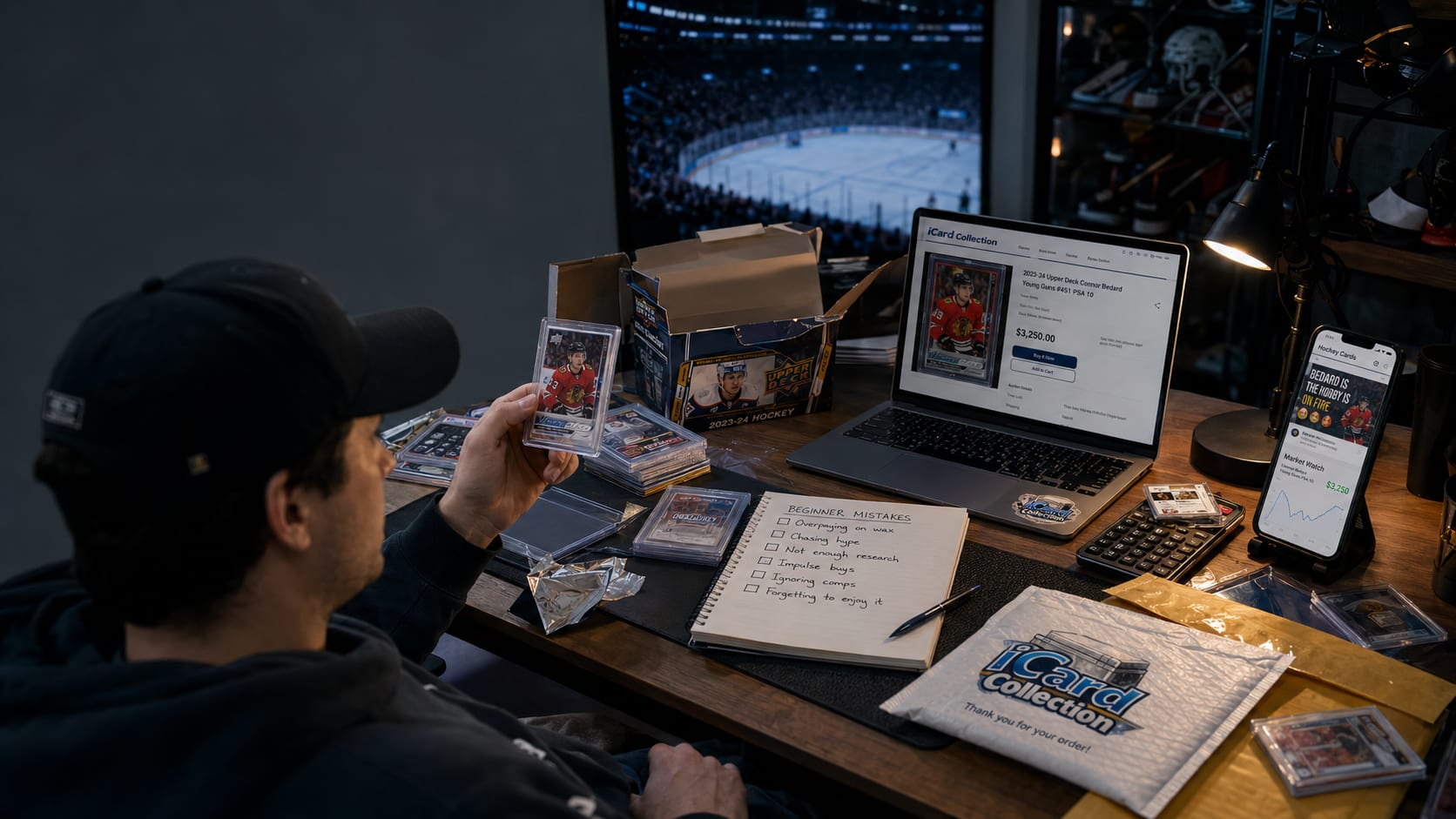
Getting into hockey card collecting today can feel overwhelming.
Social media is filled with massive pulls, expensive collections, and people claiming they turned hockey cards into a business. And while there’s absolutely nothing wrong with making money in the hobby, a lot of new collectors end up entering for the wrong reasons, and making expensive mistakes because of it.
If you’re new to hockey card collecting, here are some of the biggest mistakes to avoid.
1. Treating the Hobby Like a Business First
One of the biggest mistakes new hockey card collectors make is entering the hobby strictly to make money.
Over the past several years, sports cards and collectibles have increasingly been viewed as assets and investments. As a result, more people than ever are trying to flip cards, start “card businesses,” or chase quick profits.
The problem is that the space has become incredibly crowded.
Social media is full of:
- “buy this now” posts
- investment advice
- flipping content
- card business courses
- hype-driven markets
And while there’s nothing wrong with approaching cards from a business perspective, collectors who only focus on profit often burn out quickly.
The hockey card hobby is constantly changing. Player values fluctuate fast, hype cycles move quickly, and many modern cards are already priced at premium levels before players have fully proven themselves.
If profit is the only reason you’re collecting, you’re putting yourself in a difficult position.
The collectors who tend to enjoy the hobby the longest are usually the ones collecting players, teams, and cards they genuinely care about — not just the cards social media tells them to buy.
2. Buying Too Much Wax Too Early
Opening hockey card boxes is fun. But new collectors often underestimate what they’re actually buying: A lottery ticket.
Many collectors spend hundreds of dollars on wax hoping to pull:
- their favorite player
- a huge rookie card
- a valuable autograph
- cards worth more than the box itself
Most of the time, that doesn’t happen.
The reality is that many boxes leave collectors with:
- lower-end inserts
- parallels
- base cards
- cards that are difficult to move later
If you’re starting a hockey card collection from scratch, buying singles is usually the smarter approach.
Instead of gambling on boxes, you can:
- buy exactly the players you want
- target your favorite team
- focus on specific rookie cards
- build a collection with intention
Wax can absolutely be part of the hobby. Just don’t make it your entire strategy early on.
3. Chasing Every Hot Rookie
One of the fastest ways to build a collection you don’t actually care about is constantly chasing hype. Rookie card markets are extremely volatile.
A player can explode in value one month and cool off dramatically the next depending on:
- performance
- injuries
- media attention
- playoff runs
- hype cycles
- simply collector sentiment
We’ve already seen major swings in players like:
- Matvei Michkov
- Connor Bedard
- Lane Hutson
- Macklin Celebrini
Some markets skyrocket early. Others cool off. Some players slowly build momentum over time. The point is: hype changes fast.
Established stars typically have much steadier markets, while rookie markets can move aggressively in both directions.
There’s nothing wrong with prospecting or taking chances on young players, just don’t build your entire collection around short-term hype.
Can you imagine if you had rushed to buy Nail Yakupov cards his rookie year...
4. Rushing to Sell Everything
A lot of newer collectors become so focused on flipping cards quickly that they end up losing value in the process.
At the end of the day, getting fair value for a card often comes down to patience. If you immediately rush every card onto auction, you’re relying heavily on timing and visibility. The right buyer may not even see your listing.
Learning how to trade hockey cards properly can often create better long-term value than constantly selling.
Trading allows collectors to:
- avoid seller fees
- avoid taxes on sales
- consolidate cards into bigger pieces
- build relationships in the hobby
Sometimes the best move isn’t immediately cashing out a card, it’s finding the right collector who values it highly.
5. Overspending Because of Social Media
Social media has made comparison a massive problem in the hockey card hobby.
You scroll through Instagram, Facebook, Reddit, or YouTube and constantly see:
- insane rookie patches
- massive one-of-ones
- high-end collections
- huge box break hits
And it becomes easy to feel like:
- “I need bigger cards.”
- “I need a better collection.”
- “I need to keep up.”
But what most people don’t see is:
- how much money was spent getting there
- how many bad boxes were opened
- how many losses happened behind the scenes
Breakers handle huge amounts of product. Of course they eventually hit monster cards. That does not mean you will.
One of the healthiest things you can do as a collector is stay focused on your own collection instead of chasing validation online.
6. Ignoring Shipping Costs and small Fees
Small fees add up much faster than new collectors realize. A $10 card with $5 shipping suddenly becomes a $15 purchase.
Cross-border shipping, taxes, platform fees, and payment processing can quickly eat into your budget — especially if you’re constantly buying low-end singles one at a time.
Smart collectors often:
- bundle purchases (COMPC listings on eBay are great for this)
- buy multiple cards from the same seller
- trade locally
- make larger deals less frequently
Being mindful of fees is one of the easiest ways to avoid overspending in the hobby.
7. Trusting People Online
Unfortunately, scams are still very common in sports card collecting. Fake cards, fake patches, misleading descriptions, and dishonest trades happen regularly across social media platforms and marketplaces.
One of the biggest mistakes new collectors make is assuming everyone in the hobby is trustworthy simply because they collect cards too.
Always verify:
- feedback
- reputation
- trade history
- tracking information
- authenticity whenever possible
This is one of the reasons platforms like iCardCollection focus heavily on reputation systems and organized trade tracking, because structure and transparency matter when trading online.
8. Thinking Expensive Automatically Means Better
Some of the most enjoyable cards in a collection are not always the most expensive ones.
A lot of newer collectors get caught up chasing:
- the biggest RPAs
- the rarest parallels
- the most expensive slabs
But sometimes nostalgia and personal connection matter more than market value. There’s nothing wrong with owning high-end cards. But some collectors would genuinely enjoy:
- multiple autographs
- memorabilia cards
- favorite players
- unique inserts
more than a single ultra-expensive centerpiece.
The best collection is the one that actually makes you excited to look at it.
Final Thoughts
The hockey card hobby is supposed to be fun.
Yes, cards can have value. Yes, people make money. Yes, markets fluctuate.
But the collectors who last the longest are usually the ones who:
- collect what they enjoy
- build relationships
- make fair trades
- stay patient
- focus on the hobby first
Don’t let hype, social media, or short-term trends completely shape your collection.
Build something you genuinely enjoy owning.